Rowan Atkinson, the actor who plays Mr. Bean, as of 2024 is worth $150 million. He’s been in 27 movies ranging from Lion King, Wonka, Johnny English, and Love Actually. When asked about his career, he said, “I consider myself incredibly lucky to be doing something that I love as my profession. Acting has always been my passion, and I believe that when you find something you truly enjoy, it doesn’t feel like work anymore.”
Most people would be surprised to find out that Atkinson’s original career path was EXTREMELY different than what he’s doing today. He studied at Newcastle University for his undergraduate degree, obtained his MSc in Electrical Engineering at Oxford, and even pursued a PhD. While pursuing his masters degree Atkinson joined a student group where he discovered he had a passion for acting and comedy. According to Brittanica, it was at this time that he began, “taking to the stage to satisfy an inner urge, he began honing the facial contortions and manic comedic genius that would soon make him famous. While attending Oxford, he began working with actor Richard Curtis and composer Howard Goodall, and together they ventured to the Edinburgh Festival. There Atkinson’s classic schoolmaster sketch rocketed him to fame. In 1979 the satirical television show Not the Nine O’Clock News introduced him to millions of British viewers, and in 1981 he became the youngest person at the time to have had a one-man show in London’s West End.”
At this point Atkinson made a sharp turn in his career, which as we know worked in his favor. He was presented with an opportunity to turn his passion into a career. Which raises the question, how did Atkinson decide to quit what he was doing?
To answer this, Atkinson will serve as an example to identify when quitting is the best course of action. The low hanging fruit from our example is there’s a time and place to quit. To quote Seth Godin in his book The Dip: A Little Book That Teaches You When to Quit:
“The next time you catch yourself being average when you feel like quitting, realize that you have only two good choices: Quit or be exceptional. Average is for losers.”
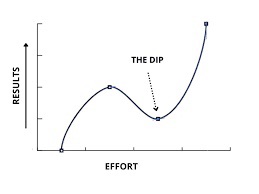
Godin in his book makes a strong case that the time when everyone is faced with the decision to stay or leave in one’s career is when there’s a dip. The dip refers to a moments like a temporary hurdle, a setback, or a frustration. It’s a time when quitting enters the mind. Godin emphasizes the importance of being able to ascertain if the current setback requires persistence as the fix or a change in direction for better outcomes. It involves assessing whether your effort is taking you closer to your goals and objectives. If your efforts don’t align and what you’re doing now isn’t expected to yield the desired results, quitting strategically is the best course of action. The alternative would be persistence.
Prior to acting Atkinson was on track for career stability. He had put 5+ years of school, tuition, and studying before he quit. He had to weigh all of that against his passion for acting. To be clear he wasn’t gambling on himself, he had been chosen to perform for millions of viewers on television. He also had experience with acting and had evidence that showed long term potential. Matthew McConaughey would label an opportunity and scenario like this a green light 🚦. For those who haven’t read McConaughey’s book Greenlights, it’s a memoir about finding one’s own path to success and fulfillment. Greenlights in the book are instances where opportunities in life align themselves with your desires, and when pursued they will propel you towards your life’s goals. Atkinson recognized the opportunity, weighed his options, and acted on the path with greater rewards.
Following Atkinson’s example, we too need to prepare ourselves and recognize the green lights ahead of us. In Austin Kleon’s Steal Like an Artist: 10 Things Nobody Told You About Being Creative, he urges his readers to:
“Don’t wait until you know who you are to get started.”
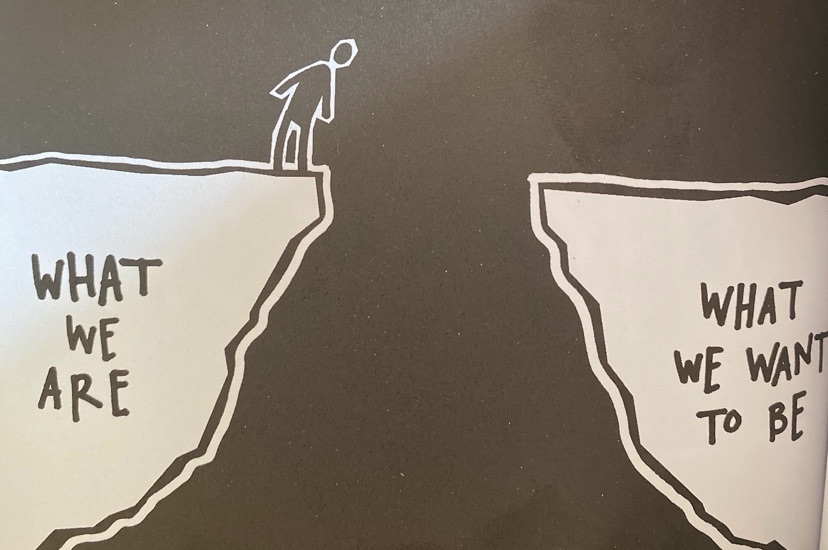
Recognizing valuable opportunities truly starts with preparation. That comes in the form of exploring hobbies, being vulnerable, and getting to know oneself. Atkinson joined acting and comedy groups while studying. How do you think he felt making faces like this in front of strangers his first time?

Creating the Mr. Bean persona after dropping out of a PhD program took guts. The average person would’ve worried what others might think, especially their peers. Atkinson knows himself, and he’s comfortable with who he is. We too need to gain similar self knowledge so we can act with confidence. To get there, McConaughey provides this framework in his book that will help navigate that process.
“The question we need to ask ourselves is: what is success to us? More money? That’s fine. A healthy family? A happy marriage? Helping others? To be famous? Spiritually sound? To express ourselves? To create art? To leave the world a better place than we found it?
What is success to me? Continue to ask yourself that question. How are you prosperous? What is your relevance?
Your answer may change over time and that’s fine but do yourself this favor – whatever your answer is, don’t choose anything that would jeopardize your soul. Prioritize who you are, who you want to be, and don’t spend time with anything that antagonizes your character. Don’t depend on drinking the Kool-Aid – it’s popular, tastes sweet today, but it will give you cavities tomorrow.
Life is not a popularity contest. Be brave, take the hill. But first answer the question.”
I love the metaphor of drinking the Kool-Aid that’s popular today but will give you cavities tomorrow. That Kool-Aid for the majority of us is safety and stability. The career ladder that offered payouts in the short term will most likely take us to a place we don’t want to be in the future. According to Careers Advice Online the average American changes their career 5-7 times in their lifetime. Another poll says that 30% of the workforce today will change careers or jobs every 12 months.
My takeaway from those numbers is that opportunities are abundant. (I acknowledge that may be an oversimplification of the numbers) However you view the responsibility, the burden or privilege is on us to recognize where our strengths, passions, and joy will provide the most value. Those factors are variables in defining success and ascertaining the answer requires serious effort.
Another metaphor I’ll use to illustrate a point is when a baby eats pizza for the first time, here’s the video for reference. Notice how the baby is in a cheesy Italian state of ecstasy 🇮🇹? It would never know the happiness that comes from pizza if they didn’t try it. The same goes for passions, strengths, weaknesses, and hobbies. One persons unexciting career path is another one’s dream.
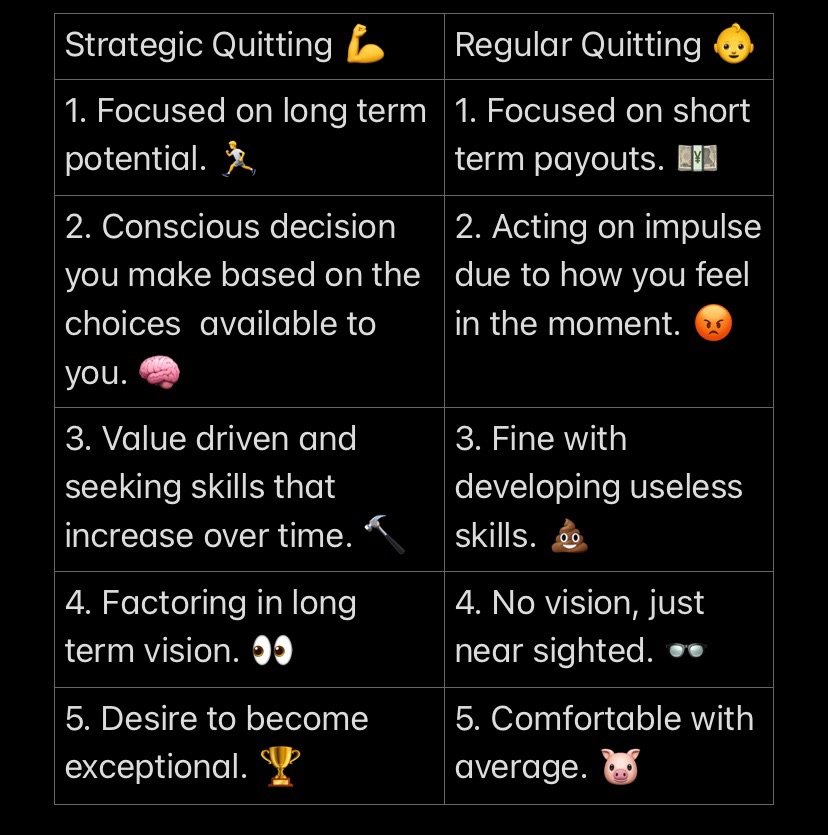
In conclusion, strategic quitting is a skill that requires cultivating self awareness and a strategic mind. Regular quitting is impulsive, runs on emotion and should be avoided at all costs.
We’re all doing the best we can and have to embrace reality. We have responsibilities, family to provide for, bills to pay, and time may not be on our side. I’d still argue that there’s no greater time or place 🇺🇸 in history than where we are now. With a growth mindset anyone can find the resources they need to pivot careers. That can come in the form of learning on YouTube, getting more formal education, reading books, reaching out to a mentor, or taking a certification course. The scales are weighed in our favor.
If you agree with what’s that’s been said follow this blog and subscribe to all the social media accounts below here:
Want wisdom that sticks? Follow this blog and the Underline This Podcast on YouTube and social media for short, impactful articles and videos that get straight to the point. Plus, explore curated tools, books, and resources on the Recommendations page—everything that’s brought real value to me, shared so it can do the same for you.
 Underline This Podcast